
What Can You See Now That You Couldn’t at Twenty-Five?
By now you have watched relationships deepen and fray. You have seen plans succeed and fall apart. You have discovered that people you once dismissed were right about a few things.
That perspective is wisdom, and it was in you long before you thought to call it that. It shows up as clearer sight, steadier choices, and a sharper sense of what deserves your attention.
The Masterwork Years are the stage when that wisdom is ready to reach other people. You have knowledge worth sharing, stories worth telling, and ideas that waited decades for the right moment.
Decades of learning and living have value beyond the person who lived them. What you discovered can help someone facing the same choice. What you learned can save another person years. What you made can reach people you may not meet.
Why Would Anyone Need to Grow Up Twice?

Watch a child at Christmas and you see the first kind of wonder at full strength: lights in the window, a tree that appeared overnight, a morning that can’t come fast enough. Each December, the season invites adults to borrow some of that wonder back.

“I think you grow up twice. The first time happens automatically.” That first growing up, author Nate Staniforth explains, is marked by the moment the weight of the world overshadows the wonder of the world. The line comes from his 2018 book, Here Is Real Magic: A Magician’s Search for Wonder in the Modern World.
The second growing up is different in kind. It asks you to rediscover wonder with full knowledge of hardship, disappointment, uncertainty, and loss. The first arrives with the calendar. The second arrives when you choose it.
Innocence and wonder are easy to confuse. Innocence hasn’t yet learned how hard life can be. Wonder has learned it, and stays open anyway.
That is why the second growing up so often comes later. It needs the decades first. Experience supplies the contrast that sharpens amazement, the way a sunrise means more to someone who has sat up through a long night.
A different kind of magic waited in a strip mall in Lancaster, California. In the summer of 1968, a 12-year-old named Jim Doty wandered into a small magic shop. The owner was out, and his mother, Ruth, was minding the counter. She offered to teach the boy magic the shop didn’t sell, if he came back every day that summer.
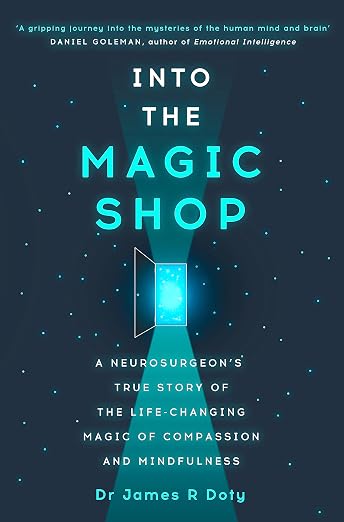
None of what Ruth taught him involved sleight of hand. She showed him how to relax his body, quiet his mind, and open his heart. Decades later, as a Stanford neurosurgeon, Dr. James R. Doty told the story in his 2016 memoir, Into the Magic Shop: A Neurosurgeon’s Quest to Discover the Mysteries of the Brain and the Secrets of the Heart. The mysteries of the brain became his profession. The secrets of the heart are wonder and love, and the boy who learned them at twelve had to learn them again as a grown man.
Sherrie Rose says that wonder keeps you alive. Many people, particularly in retirement, add that a sense of purpose keeps them going.
What they describe is Enhavim: purpose and mission led by vision. Vision leads, purpose fuels, and mission fulfills. Wonder keeps your eyes open to what is possible, and Enhavim gives those possibilities a direction to move in.
The Other Thing That Happens Twice
Street artist Banksy once repeated an old saying: “…they say you die twice. One time when you stop breathing and a second time, when somebody says your name for the last time.”
The idea is older than Banksy, with versions in print as far back as the 1860s. It has lasted because it puts a hard question plainly. What keeps a person present after the first ending?
That saying measures a life by remembrance after it ends. Remembrance belongs to legacy, what remains when a life is over. The Masterwork Years point to a different stretch of time: the years when you are still here, still active, and still deciding.
Your masterwork develops in that stretch, while your wisdom is in motion. The relationships you nurture, the stories you share, and the people you guide all feel its reach now. Your masterwork leaves its mark on the people it reaches, whether or not your name travels with it.
What Does a Second Chance Look Like From Here?
A second chance at this stage often begins with a second look at what is already there. The interest you set aside in your thirties. The relationship that deserves a phone call. The expertise colleagues still ask you about. The idea you shelved because there wasn’t time.
This is where wonder, wisdom, and second chances meet. Wonder keeps you curious enough to look again. Wisdom tells you which of those possibilities deserve your time. The second chance is the decision to act on them.
Which Possibilities Will You Act On?
The Masterwork Years belong to a stage of life, and age has little to do with when they begin. They begin when you decide what to make of the years ahead.
You develop your masterwork from your accomplishments. It may be one significant contribution or a body of contributions across decades, as distinct as the person who develops it. Either way, it comes from your heart, mind, and soul, and it benefits people beyond you.

Start with these five:
- What still amazes me?
- What have I learned that someone else needs to hear?
- What have I always wanted to explore or experience?
- Which interest, idea, or relationship deserves another look?
- What can I develop now that will benefit others?
The calendar takes care of growing older. Curiosity stays a choice, and sharing your wisdom stays an opportunity, for as long as you are willing to take it.

The season even has a soundtrack for it. Andy Williams sang that this is “the most wonderful time of the year,” and each December It’s a Wonderful Life returns to show George Bailey, and the rest of us, how many lives one person reaches without knowing it.
The world hasn’t run out of ways to amaze you. And you haven’t run out of things to give.
Keep wondering. Share your wisdom. Take the chances still ahead.
